
The World Without Us
**<span data-text-size="large">Humanity likes to think the planet as a* s</span>tage built for our story. We cut down forests, pave over plains, dam rivers, and assume that without us, the world would just be an empty, quiet waiting room. In reality, an Earth that never saw Homo sapiens* wouldn’t be empty. It would be a roaring, crowded, hyper-dense wilderness. To see what the planet would actually look like, you only have to compare the altered version we live in today against the physical baseline nature established over millions of years.
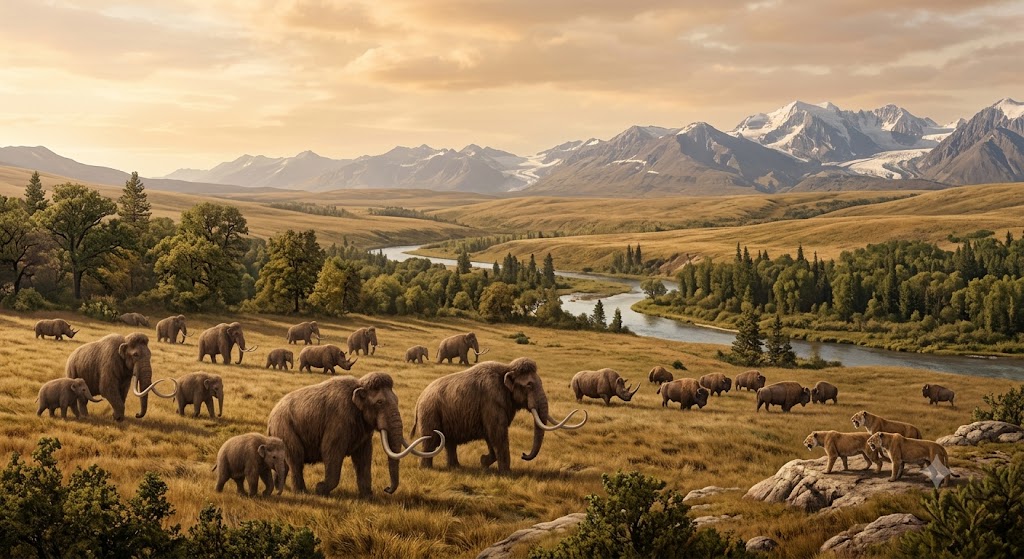
<span data-text-size="large">1. Animals: A Planet of Giants vs. A World of Livestock With Humans: </span>
Today, the total mass of all wild land mammals makes up less than 5% of all mammal biomass on Earth. Humans and our domesticated livestock (cows, pigs, sheep) make up roughly 95%. Instead of diverse apex predators and massive wild herds, the modern terrestrial mammal landscape is dominated by factory-farmed cattle and domestic pets.
Without Humans: The entire planet would look like a giant, uninterrupted African savanna. The Pleistocene mass extinction which wiped out roughly 177 species of large mammals between 50,000 and 10,000 years ago, correlates directly with the spread of early human hunting across the globe. Without human spears and habitat pressure: North America: You wouldn't just see deer and black bears. You would see 4-ton imperial mammoths, wild horses, camels, and saber-toothed cats (Smilodon) roaming the grasslands of North Texas and California.
South America: Volkswagen-sized armadillos (glyptodonts) and giant ground sloths (Megatherium) weighing up to 4 tons would carve out paths through the Amazon and the Pampas.
Europe: Woolly rhinos, cave lions, and giant Irish elk with 12-foot antler spans would occupy the forests of modern-day France and Germany.
Australia: Ten-foot-tall flightless birds ([Genyornis](https://en.wikipedia.org/wiki/Genyornis){target=_blank}) and [Diprotodon](https://en.wikipedia.org/wiki/Diprotodon){target=_blank}, a marsupial the size of a rhinoceros, would dominate the Outback. In short: Africa isn't the only continent naturally built for megafauna; it is simply the only place where big animals co-evolved alongside early humans long enough to survive us.
<span data-text-size="large">2. Forests: Fragmented Farms vs. Continual Canopies </span>
With Humans: Since the dawn of agriculture, humans have cleared roughly 46% of the world's trees. Europe, which was once almost entirely covered in dense temperate broadleaf forests, has lost over half of its original tree cover to farmlands, timber yards, and urban sprawl.
Without Humans: Forests wouldn't just be larger, they would function entirely differently due to the presence of large animals. [Megafauna](https://en.wikipedia.org/wiki/Megafauna){target=_blank} as Forest Engineers: Big animals don't destroy forests, they manage them. Elephants, mastodons, and giant sloths knock down old trees, creating open light gaps in the canopy where berries, saplings, and grasses can grow. This creates a mosaic ecosystem, a mix of dense old-growth woods, open parklands, and fertile clearings.
Global Seed Express: Giant herbivores swallow massive fruits whole and trek across hundreds of miles. Without humans, large fruit-bearing trees wouldn't be restricted to isolated patches; their seeds would be distributed across entire continents in rich piles of natural fertilizer.
<span data-text-size="large">3. The Oceans: Overfished Coastal Zones vs. Saturated Deep Seas</span>
With Humans: Modern oceans face severe pressures from commercial longline fishing, bottom trawling, and noise pollution from industrial shipping corridors. Populations of large marine predatory fish (like bluefin tuna, swordfish, and sharks) have dropped by roughly 90% since the mid-20th century.
Without Humans: The biomass in the oceans would be almost unfathomable by modern standards. Whale Pump Effect: Whales feed at deep depths and defecate near the surface. This releases massive amounts of iron and nitrogen into the sunlit surface waters, fueling giant blooms of phytoplankton. Phytoplankton absorbs carbon dioxide and feeds small fish, which feed bigger fish. Without commercial whaling, marine life at every level of the food chain would be exponentially higher than it is today.
Extinct Coastal Giants: Species like Steller’s sea cow, 30-foot-long relative of the manatee that weighed up to 10 tons—would still graze peacefully along the kelp forests of the North Pacific. Humans hunted them to complete extinction in 1768, just 27 years after Western naturalists first discovered them.
<span data-text-size="large">4. Climate and Soil: Rapid Shifts vs. Deep Carbon Storage </span>
With Humans: Industrial carbon emissions have pushed atmospheric CO2 levels past 420 parts per million (ppm), accelerating global climate shifts, melting glaciers, and shifting weather patterns worldwide. Intensive agriculture also depletes topsoil roughly 10 to 40 times faster than nature can replace it.
Without Humans: Natural Atmospheric Baseline: Atmospheric CO2 would be hovering around 280 ppm, locking the Earth into its natural orbital cycles of ice ages and warmer interglacial periods.
Deep Soil Wealth: Without heavy plowing, chemical pesticides, and artificial fertilizers, topsoil across the globe would be thick, dark, and packed with microbial life. Centuries of decaying animal matter, fallen leaves, and untouched root networks would lock vast amounts of carbon safely underground.
<span data-text-size="large">The Reality Check </span>