
Why Crocodiles Aren’t Found in the Open Ocean
For over 200 million years, crocodilians have ranked among Earth’s most effective apex predators. Surviving the mass extinction that wiped out the dinosaurs, these armored reptiles have mastered their ecological niche with terrifying efficiency. Their powerful jaws, silent movement, and armored hides make them nearly unmatched hunting machines. Yet, despite their evolutionary longevity and physical dominance, crocodilians have failed to conquer one of the largest habitats on the planet: the open ocean.
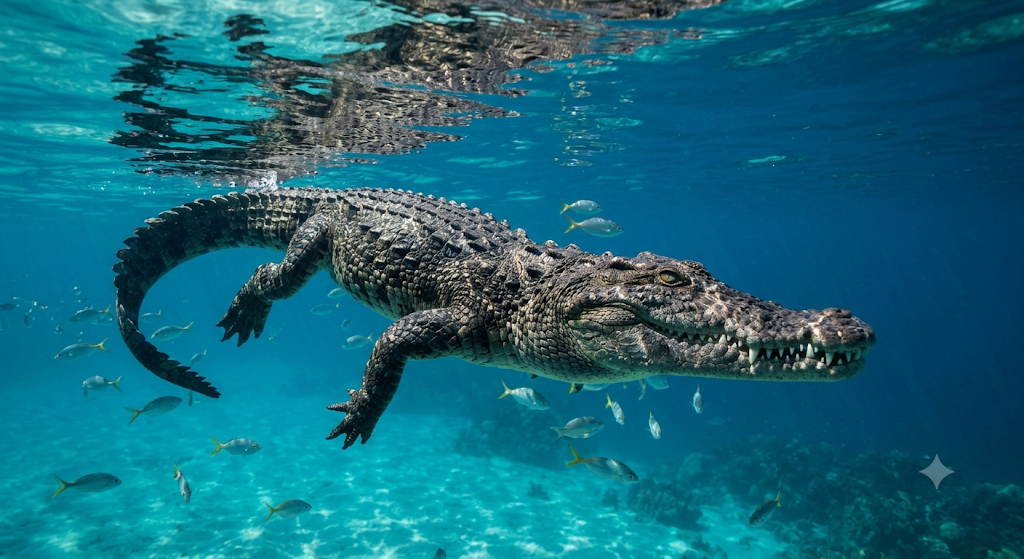
To the casual observer, this absence might seem surprising. Certain species, most notably the Saltwater Crocodile (Crocodylus porosus) and the American Crocodile (Crocodylus acutus), are well-known for swimming in marine environments. Saltwater crocodiles regularly navigate coastal bays, cross oceanic straits, and inhabit island archipelagos. However, there is a fundamental ecological distinction between traveling through the sea and living in it. Crocodiles do not form permanent, self-sustaining populations in the open ocean.
Understanding why these formidable reptiles remain bound to coasts, estuaries, and freshwater river systems requires examining their physiology, hunting mechanics, thermoregulation, and reproductive needs.
- The Physiological Barrier: Osmoregulation and DehydrationThe most immediate challenge any terrestrial or freshwater animal faces in the ocean is salt. Saltwater draws moisture out of living tissue through osmosis. Without specialized physiological mechanisms to remove excess salt and conserve freshwater, an animal living in the ocean will quickly dehydrate.
Crocodiles are actually far better equipped for marine survival than their alligator and caiman relatives. Crocodiles possess specialized lingual salt glands—modified salivary glands located on their tongues. These glands actively pump sodium and chloride ions out of the bloodstream and excrete them, allowing crocodiles to tolerate hyper-saline environments for extended periods.
However, these salt glands have physiological limits:
Lack of Efficiency Compared to True Marine Animals: Unlike sea turtles, sea snakes, or marine iguanas, which have highly evolved salt-excreting glands capable of handling exclusive saltwater intake indefinitely, a crocodile’s lingual glands cannot process hyper-saline water without limit.
The Need for Fresh Water: While adult saltwater crocodiles can survive weeks or even months at sea, they still need to drink fresh or brackish water periodically to maintain internal hydration. Young crocodiles are especially vulnerable; their salt glands are less developed, and prolonged exposure to seawater leads to rapid dehydration and death.
Kidney Limitations: Crocodile kidneys are not capable of producing concentrated urine to expel excess salt efficient enough to rely entirely on seawater for hydration.
Because they cannot survive indefinitely on pure seawater alone, crocodiles must stay within reach of freshwater sources—such as river mouths, coastal swamps, or rainfall runoffs.
- Hunting Mechanics: Built for Shallows, Not the High SeasA predator's survival depends on its ability to secure energy efficiently. The physical attributes that make crocodiles master hunters in rivers and swamps become major liabilities in the open ocean.
Ambush Tactics vs. Pelagic Chases
Crocodiles are opportunistic ambush predators. Their entire physical architecture is engineered for low-energy, explosive strikes in shallow or restricted waters:
Semiaquatic Camouflage: A crocodile hunts by lying low in the water, exposing only its eyes, nostrils, and ears above the surface. In murky riverbanks, mangroves, or muddy estuaries, this renders the predator virtually invisible to land animals coming to drink or fish swimming beneath.
Explosive Energy Burst: When prey approaches, the crocodile uses its powerful, flattened tail to launch itself forward in a rapid burst of speed, crushing the prey in its jaws.
In the open ocean, this strategy completely falls apart. The deep, crystal-clear waters of the pelagic zone offer no cover, no murky banks, and no shorelines to trap prey against. A crocodile floating at the surface of the deep ocean is visible from below and above.
Furthermore, open-ocean prey consists primarily of fast, highly agile pelagic fish (like tuna or mackerel) and cephalopods (like squid). Crocodiles lack the sustained swimming speed and hydrodynamics required to chase down fast pelagic prey across vast distances. Their hunting style requires an environment where prey can be cornered or surprised—conditions that the open ocean does not provide.
- Thermoregulation: The Cold Reality of Open Water As reptiles, crocodiles are ectothermic, meaning they rely on external environmental sources to regulate their internal body temperature. They do not generate their own metabolic heat in the way mammals or birds do.
To maintain an optimal body temperature—typically between 30°C and 33°C (86°F to 91°F)—crocodiles engage in precise behavioral thermoregulation:
Basking: During cool mornings, crocodiles crawl onto sunny riverbanks, mudflats, or rocks to absorb solar radiation.
Cooling Off: When the sun grows too hot, they retreat into the water or seek shade to prevent overheating.
The open ocean presents a severe thermodynamic challenge to an ectothermic reptile. Water absorbs and transfers heat away from the body far more rapidly than air. Continuous immersion in deep ocean water rapidly drains a crocodile's core heat.
Without land, mudbanks, or shallow rocks nearby to haul out and bask in the sun, a crocodile floating in the open sea would suffer a drop in body temperature. As its temperature falls, its metabolism slows, rendering it sluggish, incapable of efficient movement, and ultimately unable to hunt or defend itself. True marine reptiles that inhabit colder or open waters, such as the leatherback sea turtle, have developed specialized adaptations like gigantothermy and countercurrent heat exchange to maintain body heat—adaptations that crocodiles lack.
- Reproduction: The Hard Constraint of Terrestrial EggsEven if an adult crocodile could overcome the challenges of dehydration, hunting, and body temperature in the open ocean, the species would still face a insurmountable evolutionary bottleneck: reproduction.
Crocodiles are amniotes that lay hard- or soft-shelled eggs. Unlike fish or amphibians, whose eggs can develop in water, or marine mammals, which give live birth at sea, crocodile embryos require atmospheric oxygen to breathe through the eggshell during development.
The nesting requirements of crocodiles are strict:
Dry Land Nesting: Female crocodiles construct nests out of mound-building vegetation, mud, and sand, or dig holes in dry beach soil above the high-tide line.
Tidal Vulnerability: If a nest is submerged by ocean tides or storm surges for even a short duration, the developing embryos will drown inside their shells due to a lack of oxygen exchange.
Temperature-Dependent Sex Determination (TSD): The gender of crocodile hatchlings is determined by the temperature of the nest during incubation. Nests require stable soil and decaying organic matter to maintain precise thermal conditions.
Because their eggs cannot survive immersion in saltwater, every crocodile species on Earth remains tethered to dry land for reproduction. An open-ocean lifestyle is biologically impossible for a creature that must return to terrestrial ground to produce its next generation.
- The Exceptions: Ocean Travelers, Not Ocean DwellersWhile crocodiles do not inhabit the open ocean, it is important to address their remarkable ability to navigate through it. The term "Saltwater Crocodile" is not a misnomer; Crocodylus porosus is frequently sighted miles out at sea, and individuals have been recorded traveling hundreds of kilometers across open ocean waters.
How do they manage these long journeys without being true marine animals?
Recent tracking studies have revealed that saltwater crocodiles use ocean currents in a manner similar to migratory birds using wind patterns. Instead of actively swimming against powerful marine currents—which would exhaust their energy and drop their body temperature—crocodiles sit at the surface and ride strong oceanic surface currents to travel between coastlines, river deltas, and islands.
If the current shifts against their desired direction, crocodiles will often haul out onto a nearby beach or drop to the ocean floor in shallow coastal areas to anchor themselves until the tide turns in their favor.
This oceanic navigation allows saltwater crocodiles to colonize distant islands across the Indo-Pacific region, from eastern India to northern Australia and the remote islands of Fiji. However, these ocean voyages are transitional journeys undertaken to find new estuaries, territory, or mates—not a permanent lifestyle in the deep sea.
Evolutionary Limits of a Winning Design
The body plan of the crocodile is one of the most successful designs in natural history. Having remained largely unchanged for tens of millions of years, their anatomy is perfectly tailored to the interface where land meets water.
Their inability to colonize the open ocean is not a failure of evolution, but rather a reflection of specialization. To adapt fully to the open ocean, crocodiles would have to sacrifice the very traits that make them the undisputed apex predators of coastal rivers and swamps. They would need to evolve live birth (viviparity) or water-resistant eggs, hydrodynamic flippers instead of heavy clawed limbs, advanced internal heat-retention systems, and far more aggressive osmoregulatory organs.
By remaining in the shallow, rich, and dynamic zones of coasts, rivers, and estuaries, crocodiles retain their status as masters of the edge—a realm they have dominated since the age of the dinosaurs, and one they continue to rule today.